
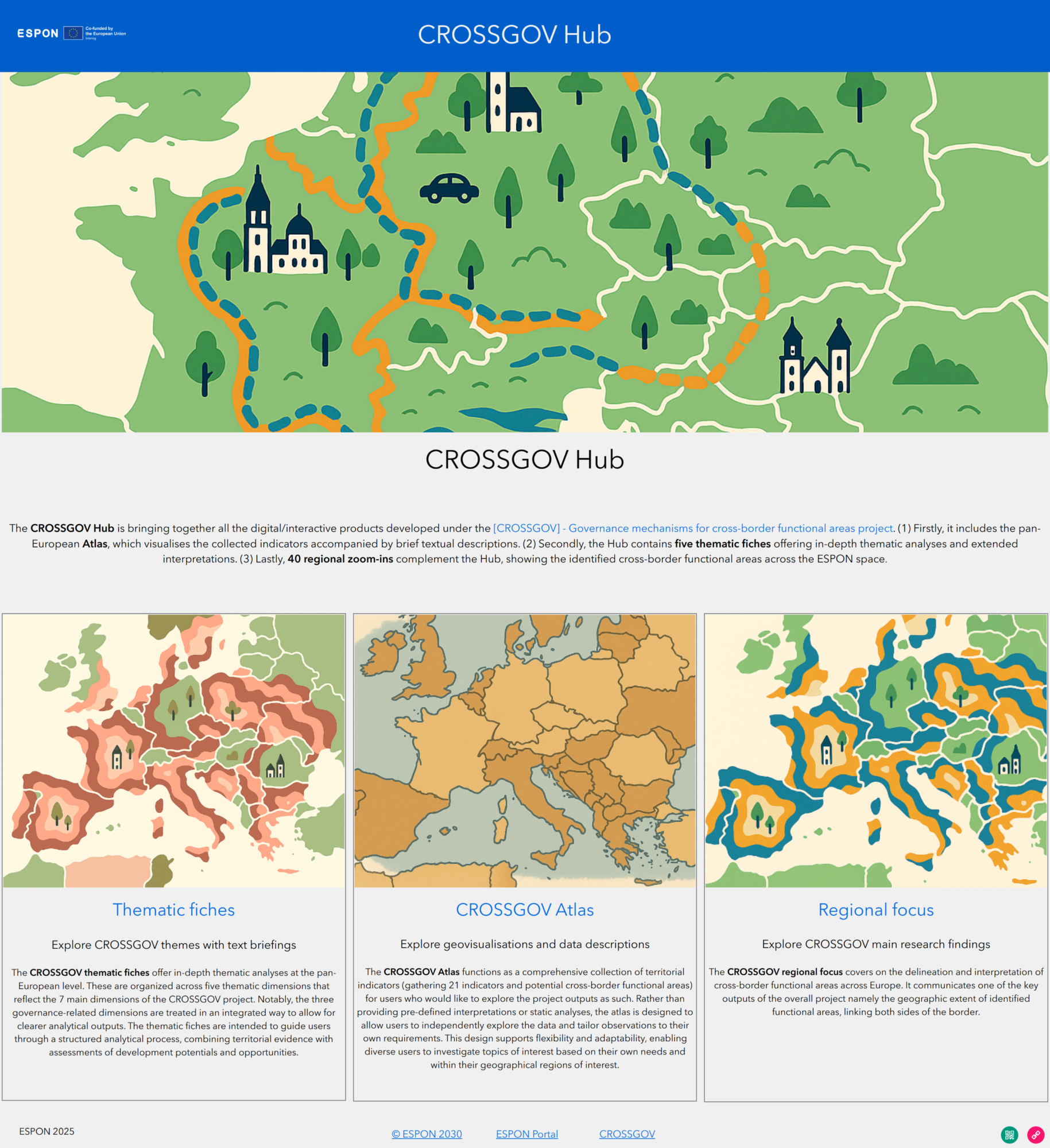
The CROSSGOV project, funded by ESPON EGTC, examined the multifaceted nature of cross-border functional areas across Europe. Various thematic aspects of cross-border regions were investigated and a collection of 21 territorial indicators can be explored via the CROSSGOV Atlas. It is part of the interactive web tool, the CROSSGOV Hub. The CROSSGOV project’s full title is „Governance mechanisms for cross-border functional areas“ and was implemented from August 2024 until recently.
The interactive web tool presents an important step towards fine-scale data availability for border regions, in particular at the pan-European level. It complements ACROSS and predominantly regional cross-border monitoring systems. Most prominently, it includes:
- a downscaling approach to outgoing cross-border commuting,
- social media data to explore cross-border connectivity,
- an anlysis of protected areas along borders,
- a calculation of natural hazard risks,
- cross-border catchment areas based on mobility flows via Twitter data,
- space-time-lines for selected cross-border connections,
- the regulatory framework of cross-border telework agreements,
- a collection of institutionalised advice centres for cross-border issues.
In-depth thematic pan-European analyses are available via the Thematic Fiches. Furthermore, the project proposes a methodological framework to identify cross-border functional areas (CBFA) across Europe. The resulting 85 CBFAs can be explored via the Regional Focus.

The accompanying final report presents the project results in a compact way, providing an integrated perspective on cross-border regions. It highlights the approach to delineating cross-border functional areas and their particular role in the debate Furthermore, an overview on cross-border governance structures and cross-cutting findings from the 10 case studies – including the results of the Futures workshops run with the stakeholders – are presented. The concluding chapter synthesises the findings from the analytical streams and puts forward a set of policy recommendations and future research needs.

More in-depth analyses on the 199 identified cross-border governance structures across Europe are available in the Compendium of multi-level governance structures in cross-border contexts. It highlights organisational, institutional, and territorial characteristics of cross-border cooperation instances and provides a comparative overview, complementing the existing work at the EU level or done within the Critical Cross-border Dictionary.
The case studies and their cross-cutting analysis complement the picture, covering a broad range (from metropolitan to maritime) of cross-border settings in Europe. Empirical research on cross-border governance structures as well as perspectives on functional areas were complemented by a participatory process, involving expert interviews and ‘future workshops’ with regional stakeholders. A particular focus were the future perspective of the cross-border regions and potential areas of cooperation.

- Espace Mont-Blanc (CH/FR/IT)
- Eurocity EUROBEC (ES/PT)
- Fehmarnbelt (DE/DK)
- Gmünd-České Velenice (AT/CZ)
- Greater Region (LU/BE/DE/FR)
- Helsinki-Tallinn twin capital region (FI/EE)
- Komárno-Komárom (SK/HU)
- Kras-Carso / Trieste (IT/SI)
- Newry-Dundalk (UK/IE)
- Trinational Eurodistrict Basel (CH/DE/FR)

This European research project was implemented together with:
- Österreichisches Institut für Raumplanung (ÖIR)
- Central European Service for Cross-border Initiatives (CESCI)
- Association of European Border Regions (AEBR)
- Palacký University Olomouc
- Politecnico di Torino
- Technische Universität Wien
- University of Helsinki
- University of Luxembourg